When Truth Comes Too Cheaply
Table of Contents
Table of Contents
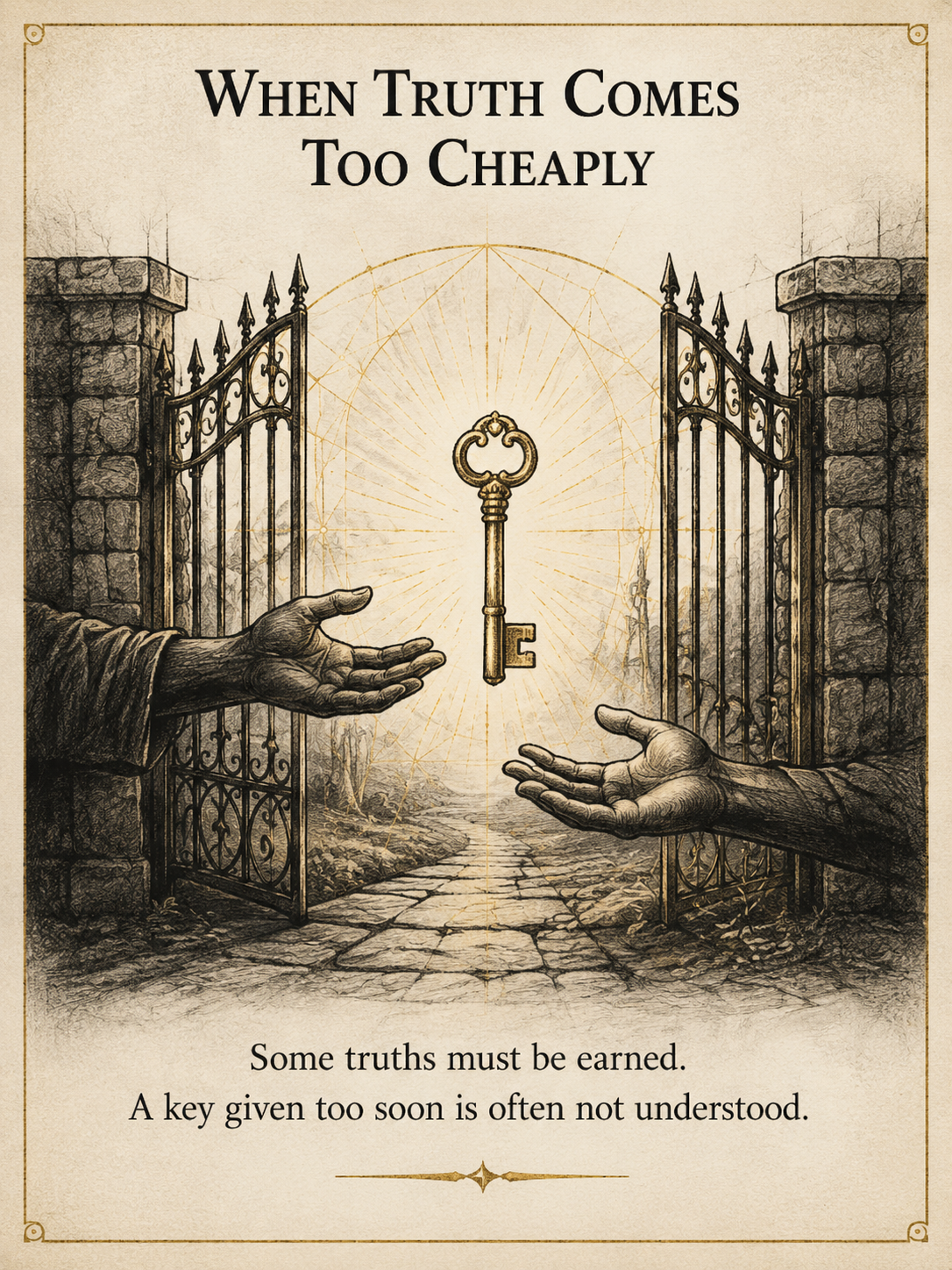
by Richard P. Weigand
Some truths lose force when they are handed over too early.
Not because they are false, but because they arrive before the person has built the structure needed to receive them.
A man can be told the answer and still not have it. He may remember the words, repeat them accurately, and even agree with them. But if he has not passed through the struggle, tension, mistake, correction, or need that gives the answer meaning, then it remains information only. It does not become understanding because it has not yet attached itself to consequence.
That is why some lessons must be earned.
When Information Has No Weight
To say that a lesson must be earned does not mean truth should be hidden, hoarded, or made unnecessarily difficult. It means that a person must sometimes develop the capacity to recognize why the truth matters.
Otherwise, the answer comes cheaply. And what comes cheaply is often treated cheaply.
It becomes one more statement among many, disconnected from life, untested, and easy to forget. The words may be correct, but they have not yet found anything within the person to fasten themselves to.
This happens in almost every field. A young craftsman can be warned about a poor cut, but the warning takes on a different meaning after he has ruined a fine piece of wood. A man can be taught about responsibility, yet the word may remain thin until he suffers the consequences of avoiding it. Someone can be told how manipulation works, but the explanation may sound merely clever until he recognizes that his own mind has been pulled by it.
The truth was present earlier.
Its importance was not.
Recognition Is More Than Agreement
This may be one reason good teachers do not merely announce answers. They lead people toward them. They allow enough observation, questioning, effort, and even error that when the truth arrives, it lands in prepared ground.
Then it is not merely heard.
It is recognized.
Recognition is different from agreement. A person can agree with a statement because it sounds reasonable or because someone he respects has said it. Recognition comes when he sees the truth operating in life and knows what it explains.
He understands where it came from.
He sees what happens when it is ignored.
He knows why it matters.
The truth has become part of his judgment rather than part of his vocabulary.
When Help Arrives Too Quickly
Those of us who care about others are often tempted to give answers away too quickly. We want to help, spare pain, prevent mistakes, and shorten the road. That impulse is often generous.
But it can also interfere with formation.
The person receives the conclusion without passing through the process that would have made the conclusion his own. The statement is handed over, but the understanding has not been built. Then the truth can sound smaller than it is because it has been separated from the path that gives it weight.
This does not mean allowing preventable harm or withholding what must be said. Some dangers should be named plainly. Some facts should be given immediately. Some situations do not permit a long process of discovery.
But many of the truths that govern character, responsibility, judgment, integrity, and restraint cannot be fully transferred through language alone. They must be approached through experience, reflection, discipline, failure, or need.
The truth may be spoken early.
Its value may only be grasped later.
Becoming Sensitive to Truth
An answer given too early can cheapen a truth by separating it from the conditions that reveal its importance. Some answers can be stated, but not truly given. A person must grow into the ability to recognize them.
That may be the deeper work of education and experience: not merely collecting true statements, but becoming sensitive to truth itself.
A person needs to recognize when something he sees or hears fits reality, explains what is happening, and deserves to guide his conduct. He also needs to sense when something is distorted, incomplete, or false, even when it arrives confidently and dressed in familiar language.
That ability cannot be borrowed.
It must be formed.
The words may come first. Understanding may come later. But when the two finally meet, truth is no longer something the person has merely heard.
It is something he can see.
—
Related Reading
- Cognitive Immunity Is Not Obsession
- What Is Truth—Really?
- Who Shapes the Mind?
- Can Moral Education Exist Without Religion?
Some answers can be stated, but not truly given. They have to be grown into.

Richard P. Weigand writes on first principles, ethics, formation, logic, media, and cognitive immunity. His work explores how people think, how character is formed, and how modern systems shape belief and behavior. Explore more on the About and Books pages.
(C)Copyright 2026 All Right’s Reserved Richard P Weigand