Truths for Teachers: Why Good Teachers Do Not Always Give the Answer First
Table of Contents
Table of Contents
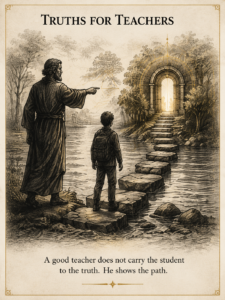
by Richard P. Weigand
There is a difference between helping someone learn and sparing him the work of learning.
At first glance, those may appear to be the same thing. A student is stuck. A child is frustrated. A friend is confused. We know the answer, we care, and we want to help. So we step in quickly, explain the point, and hand over the solution.
Sometimes that is exactly right.
But not always.
A truth given too soon can accomplish less than a struggle completed honestly. Good teachers understand this because they know that learning is not merely the transfer of information. It is the formation of understanding, and understanding is built rather than dropped in from above.
The Answer Is Not the Whole Lesson
A good teacher does not always answer the question first. He may ask one in return, allow the student to wrestle a little longer, or point toward the next step without supplying the conclusion. He gives enough help to keep the student moving, but not so much that the work of discovery disappears.
That is not cruelty. It is respect for the order by which knowledge becomes real.
A student who receives an answer too quickly may possess the words without possessing the lesson. He can repeat the conclusion without knowing why it matters, why the wrong answer failed, or how the truth was reached. He has acquired language, but the language has not yet gathered weight through effort, correction, consequence, and recognition.
That kind of learning is thin. It may sound impressive and even test well, but it often does not hold. It remains on the surface until another opinion, mood, or pressure washes it away.
Truth discovered through effort behaves differently. A young craftsman who makes a poor cut and ruins a good piece of wood remembers what no lecture could fully teach. A student who struggles with a problem, follows a wrong path, backs up, and finally sees the pattern has gained more than an answer. He knows where the answer came from, why the mistake failed, and what the understanding cost him.
That is why it stays.
The path is part of the lesson.
When Rescue Becomes Interference
This can be difficult for those who value clarity, and harder still for those who care deeply. We see confusion and want to relieve it. We see someone near discouragement and want to shorten the struggle.
But rescue can become interference.
If every difficulty is removed too quickly, the student never develops the internal structure required for real thought. He begins to depend upon supplied conclusions, looks outward before looking carefully, and gradually loses confidence in his own power to observe, test, and understand.
He may come to believe that truth is something handed down by informed people rather than something he can learn to recognize for himself.
That is not education.
It is managed dependence.
A good teacher is not trying to produce dependence. He is trying to build strength, which means he must judge something more subtle than whether the student’s answer is correct. He must judge readiness. He must sense when the student needs help and when he needs time, when silence will deepen thought and when it will merely harden confusion.
Too little help can leave the student lost. Too much can cheapen the lesson by removing the effort through which the answer would have become his own.
The teacher’s art lies in knowing the difference.
The Measure of Help
Often the best instruction comes in a measured form: a hint, a correction, a better question, a small example, or a redirection of attention. The teacher does not hide the truth, but neither does he unload it before the student has developed a place for it.
He says enough to preserve movement.
That protects the dignity of learning because it allows the student to remain an active cause in the process. He is not merely receiving a conclusion. He is participating in its discovery.
It also protects courage.
Students who are never allowed to struggle honestly may begin to fear difficulty itself. They learn to avoid uncertainty, wait for authority, and search for approved answers rather than develop judgment. Over time, this weakens more than knowledge. It weakens character.
They become less willing to try, less willing to risk being wrong, and less able to endure the discomfort that genuine learning requires.
A good teacher therefore does more than fill a mind. He helps form a person who can bear the strain of not knowing long enough to arrive at understanding.
The Restraint of the Teacher
This is one reason the best teaching is often quieter than people expect. It is less theatrical and less eager to display mastery. The teacher is not trying to prove how much he knows. He is watching what the student is becoming.
The teacher is not the point.
The growth of the student is.
That growth can be hindered when the teacher talks too much, concludes too quickly, or removes the need for effort. In that sense, restraint is part of teaching. Not every silence is neglect. Sometimes silence is what allows the lesson to ripen.
This principle reaches far beyond the classroom. Parents practice it. Mentors practice it. Wise friends practice it. Anyone who has watched another person come to an understanding in his own time knows the difference between borrowed knowledge and earned understanding.
Borrowed knowledge often has vocabulary.
Earned understanding has life in it.
Some Truths Must Be Met
None of this means that every truth should be hidden behind difficulty. Some dangers should be named directly. Some facts should be stated plainly and early. Some moments require clarity more than sequence.
But many of the most important truths in life do not merely need to be heard.
They need to be met.
Responsibility, restraint, integrity, consequence, discernment, and courage are not fully absorbed because someone defines them well. They become real when a person encounters them through work, error, failure, correction, and recognition.
The teacher cannot do that part for the student. He can only protect the conditions in which it may happen.
That may be the deepest reason good teachers do not always give the answer first. They know the answer is not the whole gift.
Sometimes the greater gift is helping another person become capable of truly receiving it.
Related Reading
- When Truth Comes Too Cheaply
- Can Moral Education Exist Without Religion?
- Who Shapes the Mind?
- Cognitive Immunity Is Not Obsession
A truth discovered through effort behaves differently. It roots itself.

Richard P. Weigand writes on first principles, ethics, formation, logic, media, and cognitive immunity. His work explores how people think, how character is formed, and how modern systems shape belief and behavior. Explore more on the About and Books pages.
(C)Copyright 2026 All Right’s Reserved Richard P Weigand