The Individual, Ethics, and the Social Order: Basics of Society
Table of Contents
Table of Contents
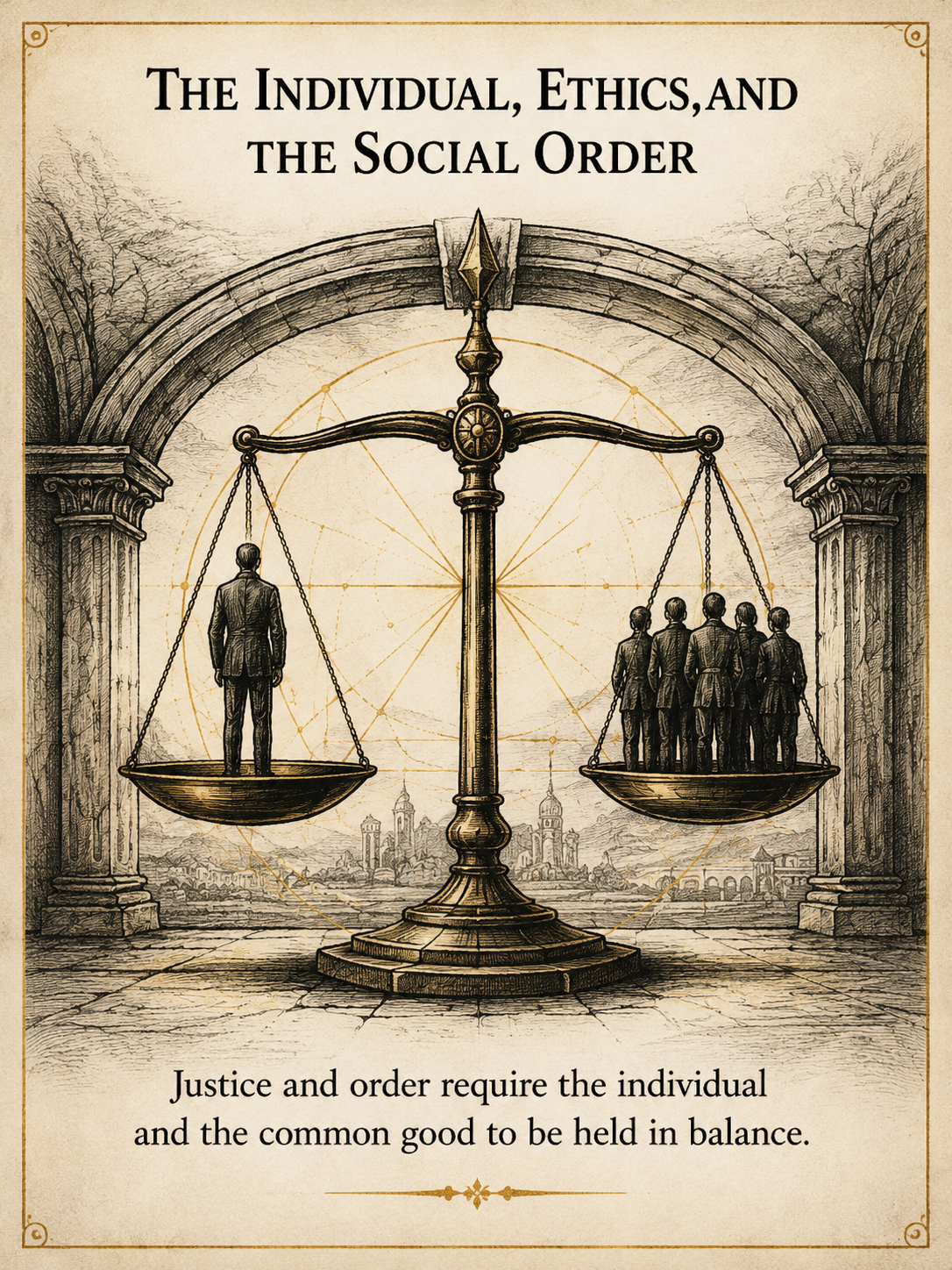
by Richard P. Weigand
A society is not made up of individuals alone. It is made of individuals, families, groups, institutions, and the larger order that allows them to live together. These are not separate layers with no effect upon one another. Each depends upon the others, and when one part is given the importance of the whole, disorder follows.
That, I think, is one of the central confusions of modern life.
The individual matters profoundly. He is not expendable, and he is not merely a cog in a machine. But neither is he an island. He comes out of realities that precede him: male and female, family, language, moral training, social expectation, inherited institutions, and the structures that make civilized life possible. He does not create himself, nor does he sustain himself alone.
The trouble begins when the individual is no longer understood as a person living within an order, but as the final authority over the order itself.
When the Self Becomes the Standard
The older assumption was that the individual should be formed within an ethical and social order. The newer assumption increasingly is that the ethical and social order must validate the individual.
That is not a minor adjustment. It is a reversal.
Once the self becomes the highest source of moral authority, the governing question changes. We ask less often, “What is right?” or “What serves the whole?” and more often, “What must the whole do to accommodate this claim?”
Sometimes accommodation is just. A decent society protects people from abuse, restrains unfair power, and recognizes the dignity of the person. But equal protection is not the same as giving every personal claim authority over the social order. The law should protect every person under the same standard. The claim itself must still be judged by its truth, consequence, importance, and relationship to the whole.
This is where proportion becomes essential. Every person deserves standing, but every demand does not deserve equal weight in every decision. A genuine hardship may deserve compassion without becoming the governing principle of a town, an institution, or a society. Once that distinction is lost, public life begins to move by grievance, pressure, and retaliation rather than judgment.
Why Ethics Comes Before Law
Ethics is what allows a society to make these distinctions. It is not a decorative subject or an optional philosophy for reflective people. It is the shared reasoning by which a group decides what is right, what is forbidden, what is owed, what must be restrained, and what serves the common good.
Without that shared moral reasoning, a society becomes a collection of competing claims managed by rules, procedures, and pressure. The people may still occupy the same territory and live under the same government, but something inward has weakened. They no longer govern themselves by a broadly understood moral order.
Then law must do more.
Ethics governs inwardly. Law governs outwardly when inward government has failed. Where character can no longer be assumed, administration expands. Where restraint cannot be trusted, rules multiply. Where people no longer ask whether an action is right, they begin asking only whether it is legal.
That is already a confession of ethical decline.
The standard becomes narrower. Can I get away with it? Will the lawyers permit it? Will compliance approve it? Is there enough political cover? Can the public reaction be managed?
That is not morality. It is the management of exposure, and no society can remain just for long when legality becomes its highest available standard.
The Loss of Moral Proportion
Ethics gives more than rules. It gives proportion. It helps us judge the relationship between liberty and obligation, compassion and responsibility, the individual and the group, present desire and long-term survival.
Without proportion, one good can begin to damage another. Compassion detached from responsibility can weaken agency. Freedom detached from consequence can become license. Order made absolute can suffocate life. Individual dignity enlarged into individual sovereignty can require families, institutions, and laws to bend around claims they cannot absorb without injury.
The difficulty is that the enlarged good may still be a real good. The person defending it can point to something true. He can say that freedom matters, that suffering is real, or that dignity must be protected. The error is not always in the thing itself. It may lie in the importance assigned to it.
This is how a part begins to govern the whole.
A society loses proportion when one principle is made to carry the entire moral weight of civilization. The individual matters, but he is not the whole. The group matters, but it is not the whole. Liberty matters, and so does restraint. Mercy matters, and so does justice. The work of ethics is not to erase one in favor of another, but to keep them in right relationship.
What Education Failed to Preserve
A self-governing people must be taught how to think and how to judge. Education must therefore do more than prepare students for employment, specialization, compliance, or procedural operation. It must help form the person.
The older purpose was not merely to place information in the mind. It was to develop reason, responsibility, judgment, and restraint. A citizen needed to know how to inspect a claim, compare it with reality, consider consequences, and ask whether an action served more than immediate pressure.
When ethics weakens and logic is neglected, public life does not become neutral. It becomes vulnerable. Emotion begins to replace judgment. Narrative replaces observation. Repetition replaces evidence. Organized pressure replaces proportion.
People may become skilled at operating systems while remaining unable to judge the ends those systems serve. Eventually, we are governed by people formed in those weakened institutions. Some are corrupt. Some are sincere. Many simply know procedure better than purpose.
They know what is permitted, but not necessarily what is right.
They know how to answer pressure, but not how to judge the common good.
They know how to manage appearances, but not how to reason from first principles.
That distinction matters because institutions do not remain directed toward the common good automatically.
Institutions Without an Ethical Center
Institutions must be held to their purposes by people capable of moral judgment. Once ethics is displaced, the institution begins serving whatever pressure is strongest, best funded, best organized, or most threatening.
Its language may remain noble. It may continue speaking of justice, safety, fairness, dignity, and service. But the words no longer arise from a stable moral center. They become instruments inside a contest for control.
This is why institutions can speak the language of principle while acting from convenience, donor interest, faction, ideology, administrative self-preservation, or private advantage. The language survives after the order behind it has weakened.
That is not accidental. It is what happens when ethics is replaced by procedure and logic is replaced by narrative.
The institution still knows how to operate.
It no longer knows clearly what it is for.
Restoration, Not Retaliation
The answer is not rage alone, nor nostalgia, nor endless attack upon one faction, one ideology, or one set of officials. The deeper problem is formation, and the answer must therefore be restoration.
Ethics must again become a serious subject. Not slogans, vague kindness, institutional values statements, or therapeutic sentiment, but the study of duty, restraint, responsibility, justice, obligation, and the common good.
Logic must also return. A people unable to inspect information, recognize distortion, compare claims with reality, and think beyond emotional pressure cannot govern itself fairly. Logic is not cold. It is one of the means by which reality is kept from dissolving into power, repetition, and narrative.
Those who govern must also be called back to questions larger than legality. Is this right? Is it proportionate? Does it preserve the structures upon which the whole depends? What precedent does it set? What does it reward? What does it weaken? Who will bear the cost later?
These are not abstract philosophical questions. They are the proper questions of government because government cannot act justly without them.
The Individual Within the Whole
The individual matters, but he cannot carry the whole moral weight of civilization. He is formed within family, language, inheritance, group, and ethical order. He receives from the whole long before he is capable of contributing to it.
A healthy society protects him without enthroning him. It applies the same law to every person while judging each claim according to its facts, consequences, and proper importance. It recognizes liberty, but not liberty detached from obligation. It recognizes compassion, but not compassion that destroys responsibility. It recognizes the needs of the part without losing sight of the whole.
That balance is difficult.
It is also civilization.
When it is lost, self-claim rises above the common good, procedure rises above principle, and legality rises above morality. That is not freedom. It is decline wearing the language of liberation.
If the social order is to recover, ethics must once again govern before law is forced to. Logic must protect judgment from pressure and narrative. People must be formed strongly enough to resist any government, institution, or ruling class when it departs from justice and the common good.
The health of the whole depends on it.
—
Related Reading
- The Moral Code We Had and the One We Have Now
- Can Moral Education Exist Without Religion?
- Who Shapes the Mind?
- Cognitive Immunity Is Not Obsession

Richard P. Weigand writes on first principles, ethics, formation, logic, media, and cognitive immunity. His work explores how people think, how character is formed, and how modern systems shape belief and behavior. Explore more on the About and Books pages.
(C)Copyright 2026 All Right’s Reserved Richard P Weigand