The Noble Eightfold Path as an Ethics System: What the West Could Learn from Buddhist Formation
Table of Contents
Table of Contents
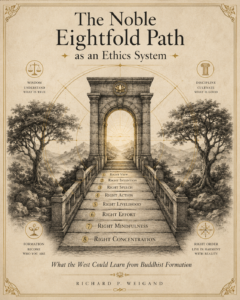
by Richard P. Weigand
Modern people often think of ethics as a list of rules.
Do this.
Do not do that.
Be nice.
Avoid harm.
Follow the law.
But older traditions usually understood ethics more deeply. They did not merely ask, “What rule did you break?” They asked, “What kind of person are you becoming?”
That is why the Noble Eightfold Path of Buddhism is worth serious attention, even for those who are not Buddhist. It is not merely a set of religious beliefs. It is a system of formation. It trains perception, intention, speech, action, livelihood, effort, attention, and consciousness.
In that sense, the Noble Eightfold Path functions as the central ethical architecture of Buddhism.
It tells a person that the moral life begins long before outward behavior. It begins with how one sees. It continues through what one intends, how one speaks, how one acts, how one works, how one disciplines the mind, how one pays attention, and how one gathers consciousness.
This is very different from the modern Western tendency to treat the self as already complete and merely in need of validation. Buddhism assumes the person must be trained. Desire must be examined. Speech must be disciplined. Attention must be governed. Conduct must be ordered.
That makes the Eightfold Path useful as a mirror. It allows us to ask what Western civilization might look like if it recovered a comparable ethics of formation.
Right View: Learning to See Clearly
The first step is Right View.
This means seeing reality as it is, not merely as we wish it to be. In Buddhism, this includes seeing suffering, impermanence, craving, consequence, and the nature of illusion.
A Western example would be the modern news consumer.
A person may believe he is simply “staying informed.” But if the news he consumes is designed to provoke fear, outrage, tribal loyalty, or despair, then he is not merely receiving information. He is being formed by a perception machine.
Right View would ask:
Am I seeing reality, or am I seeing a curated emotional picture?
Am I reacting to facts, or to framing?
Am I mistaking intensity for truth?
In Western civic life, Right View would require citizens to see beyond slogans, headlines, party loyalties, and emotional manipulation. It would train people to ask what is actually happening before deciding what they feel about it.
That is not only Buddhist wisdom. It is also civic sanity.
Right Intention: Ordering the Motive
The second step is Right Intention.
This concerns the direction of the will. What is the person aiming at? What is moving him inwardly?
In Western life, this applies powerfully to ambition.
A businessman may say he wants success. A politician may say he wants justice. A teacher may say she wants to educate. A journalist may say he wants to inform. But beneath the stated purpose may be vanity, resentment, greed, revenge, insecurity, or hunger for status.
Right Intention asks a harder question:
What is really driving this action?
A Western society that practiced this principle would not judge leaders only by what they promise. It would examine the spirit behind the promise. Does this person seek service or domination? Truth or applause? Reform or revenge? Responsibility or power?
The West once had similar language in the idea of virtue. A good act was not fully good if it came from a corrupt motive. Buddhism preserves this insight with unusual clarity.
Right Speech: Treating Words as Moral Acts
The third step is Right Speech.
This includes avoiding false speech, cruel speech, divisive speech, and useless speech.
Here the Western example is everywhere.
Social media has turned speech into a weapon, a performance, and a marketplace. People speak to wound, to signal, to provoke, to shame, to exaggerate, to gain attention. Words are treated as disposable. Yet words shape thought, relationships, reputations, institutions, and entire cultures.
Right Speech would transform public life.
It would ask:
Is this true?
Is this necessary?
Is this spoken with the intent to clarify or to injure?
Does this create understanding, or does it inflame disorder?
Imagine applying that to journalism, political debate, education, advertising, and online commentary. Much of the noise would disappear. Much of the cruelty would lose moral permission. Much of the manipulation would be exposed.
Right Speech does not mean silence. It means disciplined speech. It means words are not morally neutral. They either serve truth and order, or they contribute to confusion and harm.
Right Action: Conduct That Does Not Destroy
The fourth step is Right Action.
This concerns outward behavior. In Buddhist teaching, it includes avoiding killing, stealing, sexual misconduct, and other harmful acts.
A Western example would be family life.
A culture cannot celebrate every appetite and then wonder why families weaken. Desire has consequences. Betrayal has consequences. Addiction has consequences. Selfishness has consequences. A society that treats personal choice as sacred while ignoring the damage caused by those choices will eventually lose its moral structure.
Right Action restores the obvious:
What I do affects others.
Freedom without discipline becomes harm.
Private behavior has public consequences.
In older Western language, this was called character. In Buddhist language, action participates in karma — cause and effect. The point is not mystical only. It is practical. Actions plant seeds. A civilization harvests what its people repeatedly do.
Right Livelihood: Work Under Moral Judgment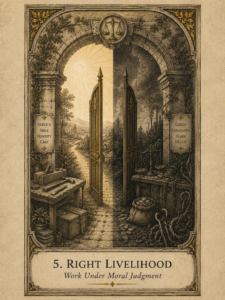
The fifth step is Right Livelihood.
This is one of the most important parts of the Eightfold Path for modern Western civilization. It says that how a person earns a living is not outside ethics.
That idea alone would challenge entire industries.
Can one make a living by addicting children to screens?
Can one profit from public confusion?
Can one build a career by making people anxious, vain, angry, or dependent?
Can one manipulate desire for money and still claim moral innocence?
Right Livelihood would force advertising, technology, media, finance, entertainment, education, and medicine to face ethical examination. It would ask whether an industry serves human flourishing or feeds on human weakness.
The West often separates money from morality. If something is legal and profitable, it is treated as acceptable.
The Eightfold Path does not allow that escape. Work forms the worker. Work affects the community. Work either reduces suffering or increases it.
That is a profound civilizational principle.
Right Effort: Discipline Against Inner Disorder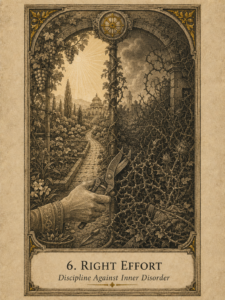
The sixth step is Right Effort.
This means actively cultivating wholesome states and restraining destructive ones. It assumes the mind does not become ordered by accident.
A Western example would be education.
Modern education often emphasizes expression, opinion, creativity, and self-esteem. But students also need the discipline of attention, patience, memory, perseverance, emotional restraint, and intellectual honesty.
Right Effort would say that the student must not merely be encouraged. He must be trained.
He must learn to resist laziness.
He must learn to complete difficult work.
He must learn to correct error.
He must learn not to surrender to every impulse.
This is not oppression. It is formation.
A society that abandons discipline in the name of kindness will eventually produce fragile people. Right Effort reminds us that compassion without training may leave a person weak.
Right Mindfulness: Governing Attention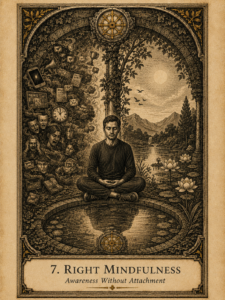
The seventh step is Right Mindfulness.
This means sustained awareness of body, feeling, mind, and mental objects. It trains a person to observe rather than be ruled by impulse.
In the West, the obvious example is the attention economy.
Phones, apps, notifications, short videos, news feeds, and algorithms compete to capture the mind. The modern person is not merely distracted. He is being trained in distraction.
Right Mindfulness would ask:
Who owns my attention?
What am I allowing into my mind?
Do I observe my emotions, or do I obey them?
Can I pause before reacting?
This is no small matter. A person who cannot govern attention cannot govern thought. A person who cannot govern thought cannot govern action. A civilization full of distracted people becomes easy to manipulate.
Mindfulness, properly understood, is not merely relaxation. It is sovereignty over attention.
Right Concentration: Gathering the Scattered Mind
The eighth step is Right Concentration.
This refers to disciplined, gathered attention. In Buddhist practice, it is closely tied to meditation and the training of consciousness.
A Western example would be craftsmanship.
The craftsman, musician, writer, scientist, athlete, or serious student must learn to gather the mind. Deep work requires concentration. Excellence requires sustained attention. Wisdom requires more than reaction.
Modern life scatters the mind. It rewards speed, novelty, interruption, and emotional stimulation. Right Concentration moves in the opposite direction. It says the mind must become steady.
A civilization that loses concentration loses depth.
It may still produce information, but not wisdom.
It may still produce entertainment, but not art.
It may still produce opinions, but not judgment.
Right Concentration reminds us that the formed mind can remain present long enough to see, understand, and act rightly.
A Formation System, Not Merely a Belief System
The Noble Eight fold Path is often described as religious doctrine. That is true, but incomplete.
It is also a system of ethical formation.
It forms how a person sees.
It forms what a person intends.
It forms how a person speaks.
It forms how a person acts.
It forms how a person works.
It forms how a person disciplines himself.
It forms how a person attends to reality.
It forms how a person gathers consciousness.
That is much broader than morality as rule-following.
For Western civilization, the comparison is instructive. The older West also had formation systems: classical virtue, Christian discipleship, apprenticeship, liberal education, codes of honor, family discipline, civic responsibility, and professional ethics. These systems assumed that the individual had to be shaped toward truth, restraint, duty, and wisdom.
Modern culture often assumes the reverse. It treats the self as the source of truth and asks society to validate it.
The Noble Eightfold Path challenges that assumption.
It says the self is not automatically wise.
Desire is not automatically trustworthy.
Speech is not automatically harmless.
Work is not automatically innocent.
Attention is not automatically free.
The mind is not automatically ordered.
The person must be formed.
That is the lesson Western civilization can draw from Buddhism without becoming Buddhist. It can recognize that a culture survives only when it teaches people how to see, speak, act, work, attend, and discipline themselves.
Ethics is not merely what one believes.
Ethics is the architecture by which a human being is built.
Related Reading
- What Is Ethics — Really?
- Formation Requires Intention
- Structure Before Freedom
- What is Discipline?
- What Is Honor vs. Reputation — Really?
- The Mercy of Not Looking
- The News Machine
- Books

Richard P. Weigand writes on first principles, ethics, formation, logic, media, and cognitive immunity. His work explores how people think, how character is formed, and how modern systems shape belief and behavior. Explore more on the About and Books pages.
(C)Copyright 2026 All Right’s Reserved Richard P Weigand