The Mercy of Not Looking: Why People Avoid the Truth They Already See
Table of Contents
Table of Contents
The Mercy of Not Looking
There is a strange mercy in not looking.
At least, that is how many people experience it. If they do not look too closely, they do not have to know. If they do not know, they do not have to act. If they do not act, they can still tell themselves they are innocent.
But that kind of mercy comes at a cost.
It protects comfort, not truth. It preserves the appearance of peace while leaving the disorder untouched. It allows a person to move through life as if the thing they sense is wrong has not yet become their responsibility.
This may be why people often avoid the obvious.
They do not look away because the thing is vague.
They look away because it is obvious.
Seeing Creates Responsibility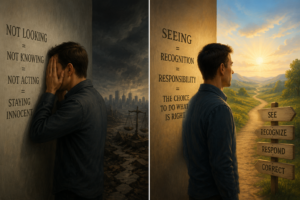
The price of seeing is responsibility.
Once truth enters the room, innocence has to leave. A person can still deny what he has seen. He can rationalize it, explain it away, cover it with language, or call it more complicated than it really is. But he cannot return to the same state of not knowing.
Recognition changes the condition of the mind.
Before a thing is seen, it can be excused. After it is seen, it must be answered.
This is true in personal life. It is true in families. It is true in institutions. It is true in culture. The moment a pattern becomes visible, the person who sees it stands at a fork in the road.
He can correct it.
He can confront it.
He can remain silent.
Or he can begin the long work of pretending he did not see what he saw.
That last option is more common than most of us like to admit.
Why People Become “Reasonable”
Reasonableness often arrives just in time to protect a man from seeing what he already knows.
This is one of the mind’s cleverest defenses. A person senses that something is wrong, but instead of looking directly at it, he explains why it probably cannot be what it appears to be.
He says it is complicated.
He says there must be another side.
He says people mean well.
He says it has always been this way.
He says he is not qualified to judge.
Some of these statements may be true in some situations. Prudence matters. Humility matters. It is wise not to rush into accusation.
But reasonableness can also become camouflage.
It can become a way of avoiding recognition. It can keep a person just far enough from the truth that he never has to answer it.
People call it complexity when simplicity would make them responsible.
To Indicate Is to Awaken
There is another uncomfortable part of this.
Sometimes a person does not see what he is doing until someone indicates it to him.
A small observation can change everything.
“You do this every time.”
“You changed the subject.”
“You are defending the thing you said you oppose.”
“You are calling it kindness because you do not want to call it fear.”
When something is indicated correctly, the person suddenly has a choice. Before that moment, he may have been operating automatically. After that moment, he has awareness.
And awareness carries obligation.
To indicate a thing is to awaken responsibility. Once a man sees what he is doing, he must either change it or defend it.
That is why indication is often resisted.
The person may attack the messenger. He may argue over tone. He may object to timing. He may claim the point is unfair, extreme, unkind, or unnecessary. But beneath the reaction may be something simpler.
He saw it.
And now he has to do something with it.
The Mind’s Desire for Innocence
The mind has many ways to remain innocent.
The easiest is not to look.
This does not always come from cowardice. Sometimes people avoid seeing because they are tired. Sometimes they are overwhelmed. Sometimes they already carry too much. Sometimes they know that if they see one more thing clearly, they will have to rearrange their life around it.
So they lower their eyes.
They stay busy.
They laugh it off.
They change the subject.
They call the matter divisive.
They choose peace over clarity, though the peace is often temporary and the lack of clarity expensive.
The tragedy is that what remains unseen does not disappear. It waits. It grows. It becomes more difficult to correct with time.
A thing unseen can be excused.
A thing seen must be answered.
The False Mercy
This is the false mercy of not looking.
It feels merciful because it spares us the burden of decision. It lets us remain pleasant, agreeable, and undisturbed. It protects us from conflict, at least for a while.
But it is not true mercy.
True mercy does not require blindness. True mercy can see clearly and still act with patience. It can recognize disorder without becoming cruel. It can name what is happening without losing compassion.
False mercy refuses to look.
True mercy looks without hatred.
False mercy protects the comfort of the moment.
True mercy protects the possibility of correction.
That distinction matters.
Because if we confuse blindness with mercy, we will eventually defend the very things that harm us.
Once You See It
People do not fail to see because the thing is hidden.
They fail to see because seeing would require them to move.
This is why truth is so often resisted. Truth does not merely inform us. It makes a claim upon us. It asks for alignment. It demands that our words, actions, loyalties, and decisions come into better order.
That is why recognition can feel like terror.
Not because the truth is always complicated.
Sometimes it is terrifying because it is simple.
The child is being neglected.
The institution is lying.
The relationship is corrupt.
The habit is destroying the person.
The excuse is no longer believable.
The system is not broken by accident.
Once such things are seen, the old innocence is gone. The person may still refuse action, but he cannot honestly claim ignorance.
The Responsibility of Seeing
The answer is not to become reckless. Seeing clearly does not mean attacking everything immediately. Recognition should be joined to judgment, timing, courage, and restraint.
But we should not mistake delay for wisdom when it is really avoidance.
We should not call confusion what is actually recognition.
And we should not call it mercy when we simply do not want the burden of knowing.
The price of seeing is responsibility. Once truth enters the room, innocence has to leave. This is why men learn not to look too closely. They do not fear confusion.
They fear recognition.
And yet recognition may be the beginning of freedom.
Because once a person sees clearly, he can finally stop defending the fog. He can stop pretending. He can stop using reasonableness to avoid responsibility.
He can move.
He can correct.
He can answer.
He can become honest.
That is the real mercy — not the mercy of not looking, but the mercy of finally seeing what has been waiting to be seen.
Related Reading:
- What Is Truth?
- The Cost of Seeing Clearly
- Cognitive Immunity: Learning to Recognize Manipulation
- The Difference Between Reason and Rationalization
- Why People Defend What Harms Them

Richard P. Weigand writes on first principles, ethics, formation, logic, media, and cognitive immunity. His work explores how people think, how character is formed, and how modern systems shape belief and behavior. Explore more on the About and Books pages.
(C)Copyright 2026 All Right’s Reserved Richard P Weigand